
The job it does
A confidence-labelled view of what the current evidence supports.
EdgeScore, measure the evidence
An informational view of eligible simulated activity across risk, consistency, execution and risk-adjusted performance. EdgeScore remains a measurement layer within Review.
EdgeScore is part of the connected TradeRank experience available according to the member's plan and recorded evidence.
The job it does
A confidence-labelled view of what the current evidence supports.
Why it matters
A single result can hide poor process, while a good process can be obscured by a small sample.
Current product example, simulated data
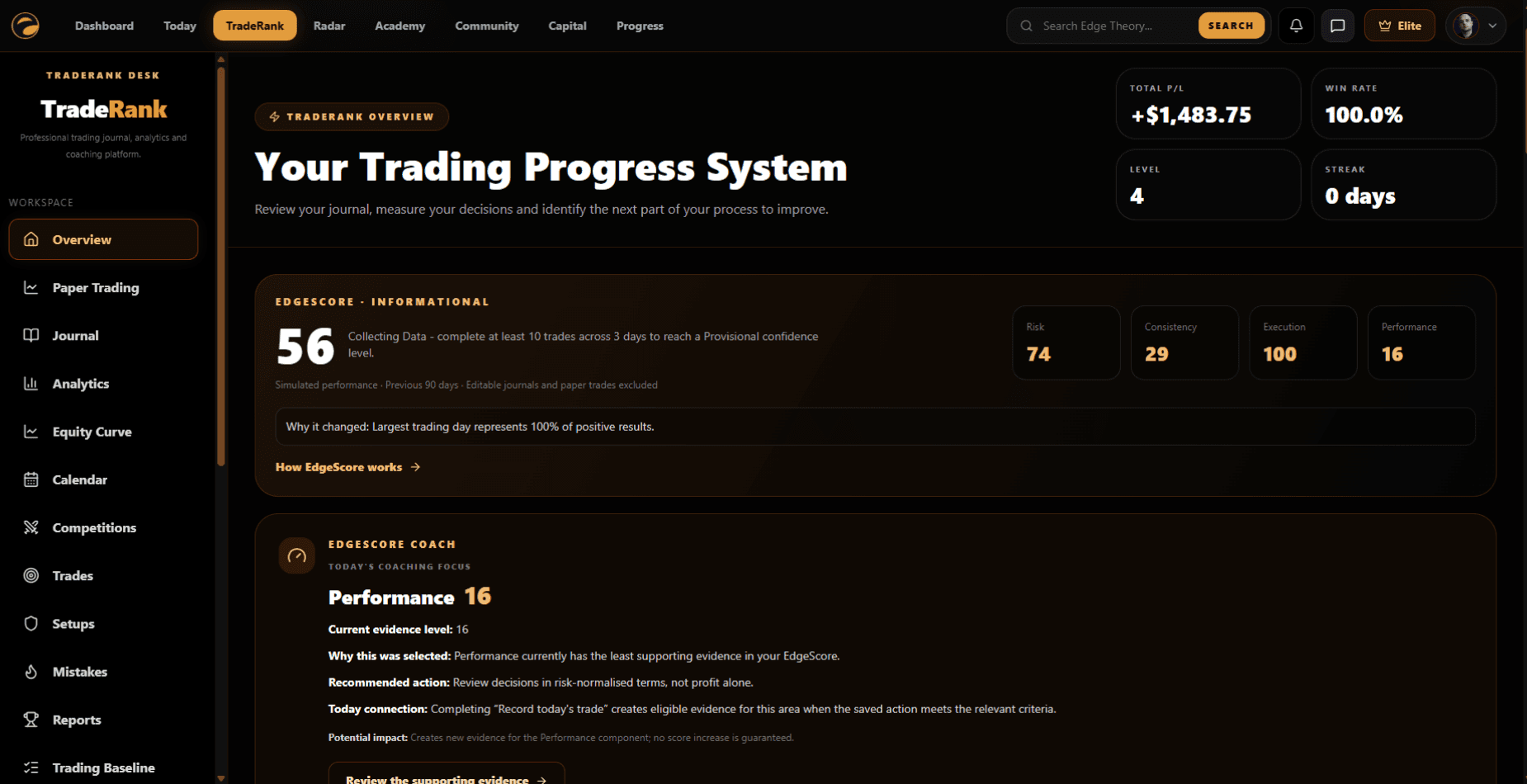
This worked example uses the current EdgeScore interface and implemented coaching logic. It shows how the number, supporting evidence and next review action remain connected.
01, the score
Eight eligible locked simulated trades across two active trading days. More evidence is required before the score reaches Provisional confidence.
The available record supports some risk controls, while further eligible evidence is still required.
Positive results are concentrated in one trading day, which weakens the evidence of repeatability.
The eligible sample supports the recorded execution checks, but confidence remains limited by activity.
This component currently has the least supporting evidence and becomes the coaching focus.
02, why it changed
Evidence detected
The largest trading day represents 100% of positive results.
What that means: The current positive result is concentrated in one session. EdgeScore therefore treats the Consistency evidence cautiously instead of assuming that one profitable day proves a repeatable process.
03, what to review next
Performance currently has the least supporting evidence in this EdgeScore.
Recommended review action
Review decisions in risk-normalised terms, not profit alone.
Potential evidence impact: Completing that review can create new eligible evidence for the Performance component. No score increase is guaranteed.
This is simulated demonstration data from the current product interface. EdgeScore is informational. It does not predict profitability, prove live-market competence or guarantee that completing an action will increase a score.
Inside the process score
Every visible component is tied to eligible recorded evidence, labelled confidence and an explanation of what changed.
Summary
01See the current informational score alongside its evidence confidence rather than treating an early sample as settled truth.
Components
02Inspect risk, consistency, execution and performance context separately.
Evidence
03Read the supporting reasons behind movement in the score and its components.
History
04Compare recent score history while keeping sample size and confidence visible.
Coach
05Identify the component with the least supporting evidence and the review action most relevant to it.
Habits
06Keep journal completion, review rhythm and goals visible without altering the core score improperly.
A score that explains itself
See why a component changed instead of receiving a black-box number.
Limited data is labelled so an early score is not presented as settled truth.
Identify the process area with the least supporting evidence and a useful next action.
Use the score alongside the underlying journal and simulated activity, not in isolation.
Evidence with its context
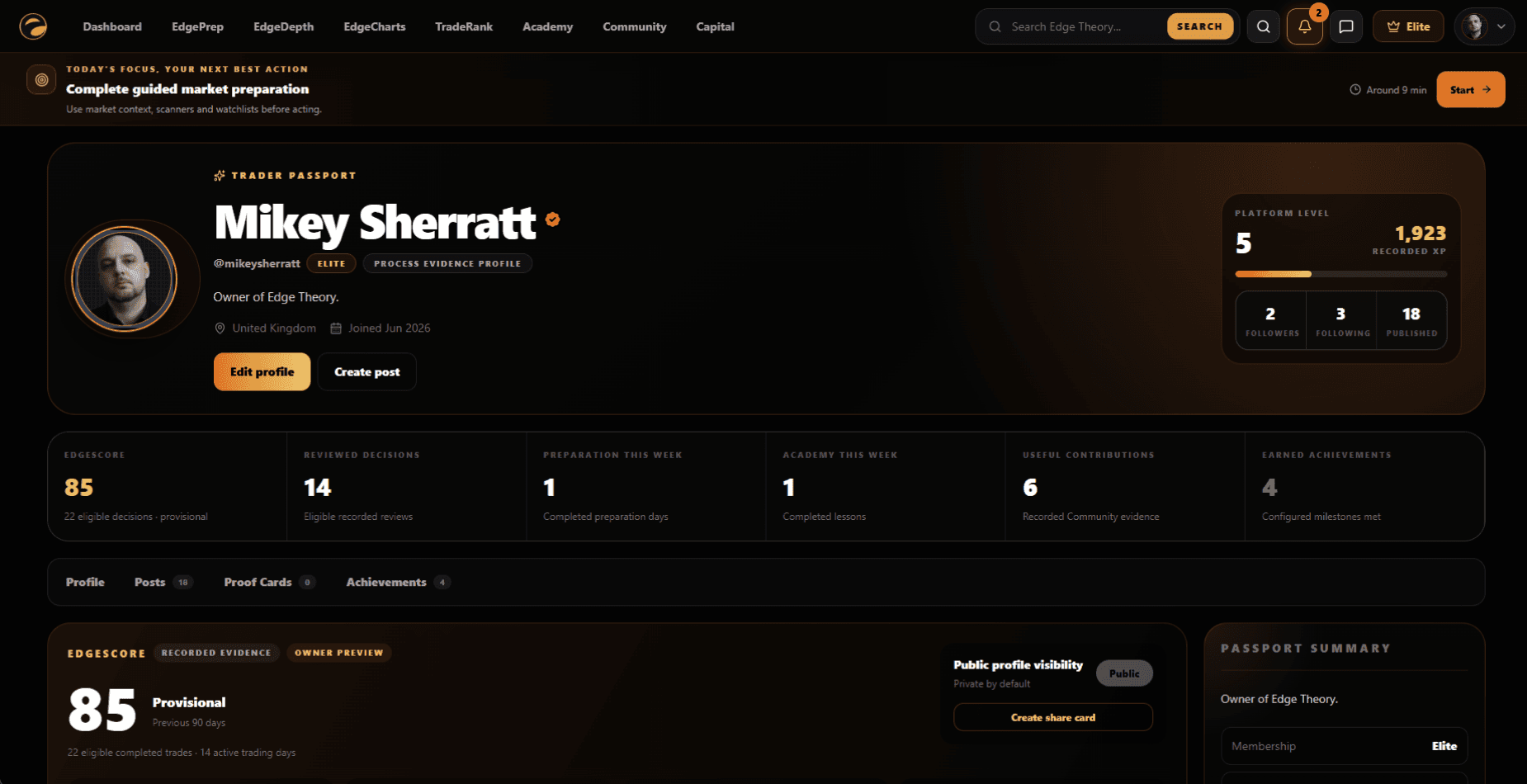
The score sits inside TradeRank so risk, consistency, execution and performance context can be checked against the underlying simulated activity and review history.
The coaching loop
Complete meaningful preparation, simulated activity and reviews.
See which evidence affected each component and its confidence.
Work on the behaviour, then review how the evidence changes.
Score and source together
The score remains useful because members can return to the simulation, journal and review history that created each component and confidence label.
Locked eligible simulated activity provides part of the underlying evidence.
The score stays connected to the record and explanations that produced it.
Component findings can point towards relevant published learning.
Developmental evidence may inform readiness guidance without guaranteeing eligibility or results.
One trading week
A product-use example, not a trading recommendation or a representation of expected results.
Complete meaningful simulated activity and the related journal or review work.
Inspect risk, consistency, execution and performance context separately.
Interpret movement in light of the current sample and evidence confidence.
Work on the weakest supported process area and return after more eligible evidence exists.
What this does not do
Current components: risk discipline, consistency, execution discipline and risk-adjusted performance context. Confidence reflects the available eligible activity. Methodology details must remain aligned with the implemented scoring rules.
Last reviewed 21 July 2026
Evidence standard
The interface demonstration above shows the current product mechanism. Member quotations appear only after membership, consent and moderation checks; absent evidence is not replaced with a broad outcome claim.
Current access: EdgeScore is part of the connected TradeRank experience available according to the member's plan and recorded evidence.
Part of the connected workflow
This page stays focused on the product mechanism, access and limitations. The complete Learn to Improve sequence is explained once on How It Works.
Edge Theory provides education, tools, simulated environments and community features. It does not provide financial advice, trading signals or guaranteed outcomes.