
01
Evidence should be inspectable.
If a system identifies an Opportunity, the trader should be able to understand the context behind that assessment rather than relying on an unexplained output.
About Edge Theory
Crypto traders have access to more charts, indicators, feeds and market data than ever. The problem is no longer finding information.
It's deciding what matters.
Edge Theory is building quantitative market-intelligence systems that continuously examine supported crypto markets, narrow the field and organise the evidence around the Opportunities worth investigating.
So instead of beginning every research session with hundreds of charts, you begin with a reason to look.
Explore Pulse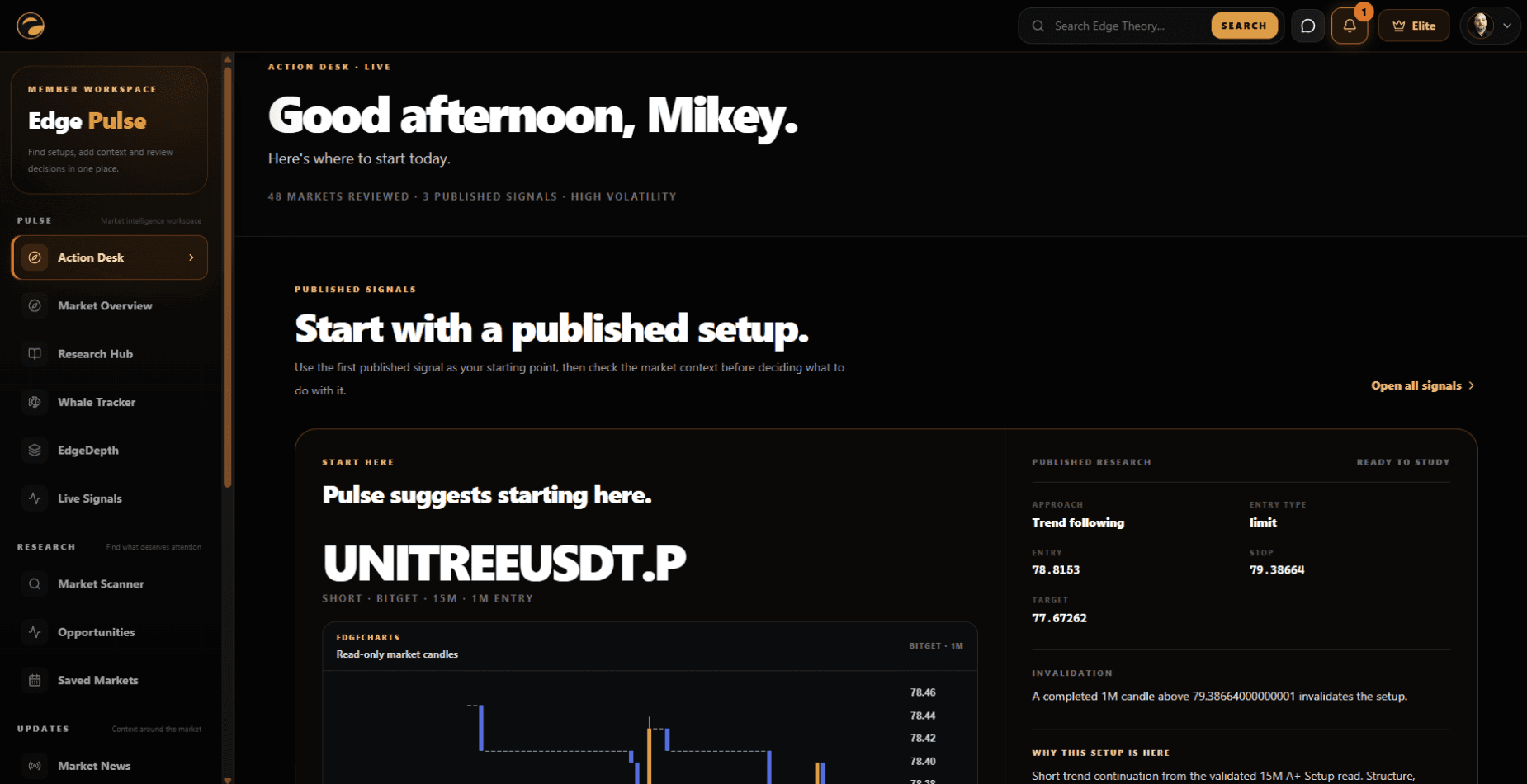
Why Edge Theory exists
Open an exchange. Check a watchlist. Move through charts. Change timeframes. Add indicators. Check another market. Look at another feed.
Eventually, something catches your attention.
But the amount of information available has grown much faster than a trader's ability to examine it properly.
We think software should do more of that first pass.
Not by deciding what you should trade. By continuously processing market information, identifying where something potentially meaningful is developing and keeping the evidence close enough for you to examine it yourself.
That is the problem Edge Theory is built around.
Our approach
Edge Theory separates market discovery from the final trading decision.
Pulse continuously analyses supported markets and ranks Opportunities worth investigating.
Each Opportunity keeps the assessment alongside the context behind it: score, confidence, market health, regime, supporting evidence, weakening evidence and how that assessment changes over time.
When research develops into a published plan, Edge Dashboard can bring the market, direction, levels, rationale and invalidation together in one place.
The research path
Edge Theory handles the organisation.
You keep the judgement.
What we're trying to improve
Trading software often concentrates on the final moments of the process: the chart, the setup, the entry.
We are interested in what happens before that.
The questions that matter
Those questions matter because a number on a screen is much less useful when you cannot understand what produced it. That's why Edge Theory isn't built around presenting a score and asking you to trust it. The evidence matters too.
What we believe
01
If a system identifies an Opportunity, the trader should be able to understand the context behind that assessment rather than relying on an unexplained output.
02
Markets rarely present perfect agreement. Evidence that weakens an assessment can be as important as evidence that supports it.
03
Scores help prioritise attention. They do not predict outcomes and they should never replace judgement.
04
Edge Theory can organise market intelligence and publish structured research. It does not know your circumstances, strategy or risk tolerance.
05
Practice balances, orders, positions and execution inside Edge Theory are simulated. They are not presented as live exchange activity.
06
A useful trading workflow should reduce unnecessary work. Every tool we add should help a trader discover, investigate, practise or review more clearly.
The system we're building
Pulse sits at the centre of Edge Theory, but the wider platform supports different parts of the research process.
Evaluate published research plans where available, including their levels, rationale, status and invalidation.
ExploreGo deeper into market structure, price behaviour and recorded evidence behind published Signals.
ExploreUse approved signals manually or build your own bot workflow with clear activity, position and simulated results.
ExploreDiscover published strategies, templates and signals, then add them to your own configured workspace.
ExploreJoin administrator-created simulated competitions with published rules and XP-backed standings.
Explore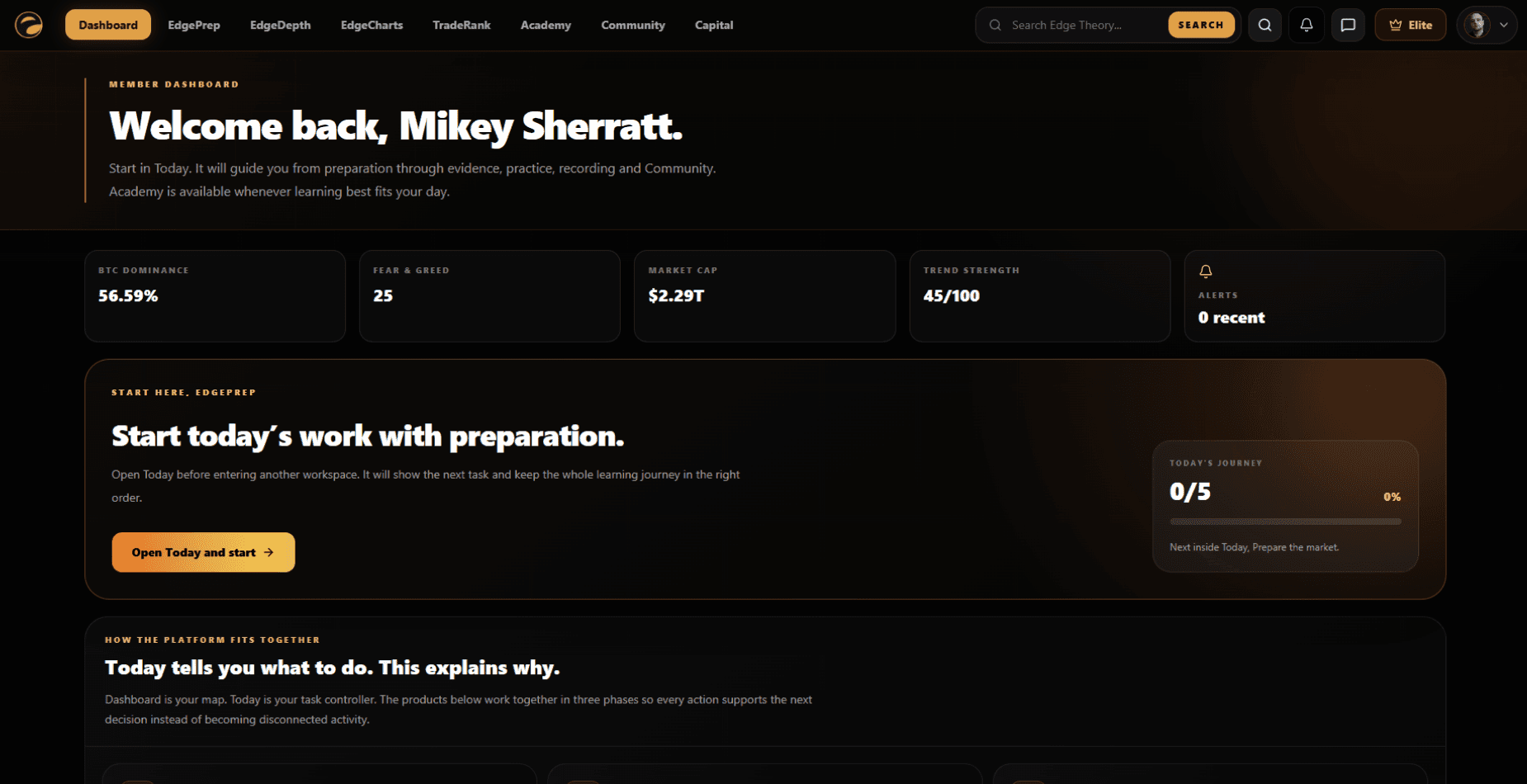
They are different tools, but they are being built around the same idea: help the trader spend more time investigating what matters and less time searching for something to investigate.
Built around real markets
Edge Theory currently works with market information from leading crypto venues including Binance Futures, Bybit, Bitget and Hyperliquid.
Different venues can show different prices, liquidity and market conditions, and third-party data can sometimes be delayed, incomplete or unavailable.
We don't think those realities should be hidden behind false precision. Where context, freshness or conflicting evidence matters, the product should make that easier to see.




What Edge Theory is -- and what it isn't
Edge Theory provides quantitative crypto market intelligence, structured research and simulated-practice tools.
Edge Theory is
Edge Theory isn't
Opportunities are not instructions to buy or sell. Published research signals are not personalised financial advice. Scores, confidence measures and model outputs do not guarantee an outcome. And simulated balances, orders, positions and fills do not represent live exchange execution.
The final decision -- including whether to trade, how to trade and how much risk to take -- remains yours.
Built in England. Built for a global market.
Edge Theory is developed by Edge Theory Capital Ltd, a company registered in England and Wales.
We are building the platform around a simple long-term question:
How much of the work surrounding a trading decision can software make clearer without pretending to make the decision for the trader?
Company identity
Contact: support@edgetheory.pro
Pulse is our answer to the discovery problem.
The wider Edge Theory platform is being built around everything that comes next: investigation, evidence, market context, simulated practice and review.
We expect the product to keep evolving.
The principle behind it shouldn't have to.
Organise the intelligence. Show the evidence. Leave the decision with the trader.
See it working
Open Pulse and look at what Edge Theory is finding now.
See the markets being surfaced, inspect the evidence behind an Opportunity and decide for yourself whether the approach makes your research process clearer.
Free registration. No card required.
Market intelligence and published research signals. Not personalised financial advice. Simulated activity remains simulated.