
The Edge Theory platform
Everything you need to understand the market , and eventually stop watching it.
Edge Theory brings crypto market intelligence, published Signals, charts, simulated practice, exchange connections and member-owned Bots into one connected platform.
Start by learning what is happening. Investigate the opportunities that matter. Use Signals manually if you want. Then build your own Bot when you’re ready to let your configured workflow keep watching while you get on with something else.
Learn first. Practise safely. Automate when you’re ready.
Paper trading is simulated. Signals are informational and not personalised financial advice. Exchange-connected functionality depends on supported connections and enabled features.
One connected platform
Intelligence that can lead somewhere.
Market
Crypto information
Pulse
Market intelligence
Signal
Structured research
EdgeCharts
Investigate and practise
Your Bot
Member-owned automation.
Signal source
Approved Edge Theory Signal
Connection
Supported workflow
Configuration
Set by the member
Monitoring
Activity and health
One Edge Theory
Different tools. One connected workflow.
Market intelligence is more useful when you can do something with it. Signals are more useful when you can understand and investigate them. Automation is more useful when you understand what you’ve asked it to do. That’s why the different parts of Edge Theory connect from understanding the market to configuring a Bot.
Understand
Pulse
Market intelligence
Structure
Signals
Published research
Investigate
EdgeCharts
Market context
Practise
Paper trading
Simulated workflow
Connect
Exchange connections
Supported mode
Automate
Your Bots
Member-owned
Review
Activity · Statistics · Health
Know where to look
Bots
The product built to give your attention back.
Crypto doesn’t wait for you to be at your desk. Edge Theory Bots are designed to reduce the amount of time you need to spend constantly monitoring markets yourself. Each member builds and configures their own Bot, chooses its approved Signal or strategy source, sets the relevant controls and limits, reviews the setup and activates it only when the configuration is valid.
Your Bot. Your configuration. Your time back.
Automation doesn’t remove market risk and it doesn’t guarantee a profitable result. The benefit is less time tied to a market that never closes.
Bots
Your Bot. Your configuration.
Bot name
BTC Trend Bot
Signal source
Approved Edge Theory Signal
Exchange connection state
Mode and permissions visible
Controls and limits
Configured by the member
Paper/Demo status remains visible wherever simulated activity is shown.
Recent activity
Signal source selected
Configuration event
Paper workflow ready
Simulated mode
No result shown
Avoids invented activity
Statistics
Mode-labelled records
Review simulated or exchange-connected activity according to its actual mode.
Health
Health view
Connection state, failures and attention points.
Pulse
Find what deserves your attention.
Crypto produces more market information than anyone can reasonably follow manually. Pulse scans and organises that information so you can move from an entire market to the areas worth investigating. Opportunities help narrow the search, research provides context and Signals can turn selected setups into a structured format. The goal isn’t to give you more to watch. It’s to help you know where to look.
Pulse / Opportunities
Existing product UI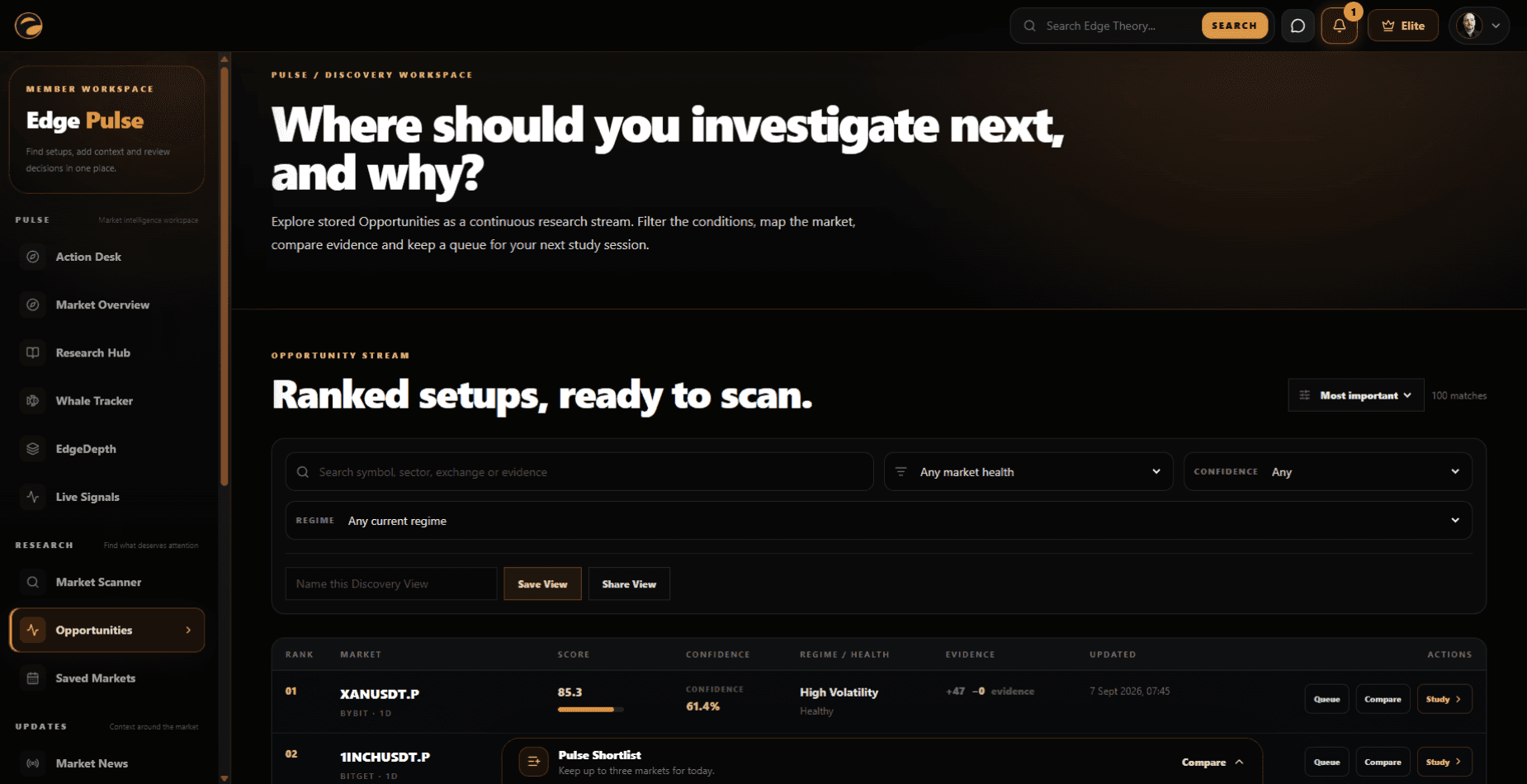
Signals
Structured research you can actually understand.
Published Edge Theory Signals organise a market setup into a consistent format. They bring the market, direction, timeframe, entry, stop, target and invalidation together so you can read the research before deciding what happens next. Use it manually, investigate it in EdgeCharts, practise through simulated trading or use an approved Signal as the source for a Bot you’ve configured.
A published Signal does not automatically activate a Bot.
Published Signal
Research with a shape.
Market
What is being analysed.
Direction
The direction of the setup.
Timeframe
The timeframe being analysed.
Entry
A level or condition.
Stop
The setup risk boundary.
Target
The setup objective.
Invalidation
What would cause the setup to no longer apply.
Choose what happens next
Manual
Investigate and practise it yourself.
Your Bot
Use it as a source for your configured Bot.
EdgeCharts
See the market behind the Signal.
EdgeCharts gives you somewhere to investigate what you’re seeing. Use exchange market data where available, charts, indicators and market studies to explore a market in context, then move from research into practical experience through paper trading.
EdgeCharts / investigate
Existing product UI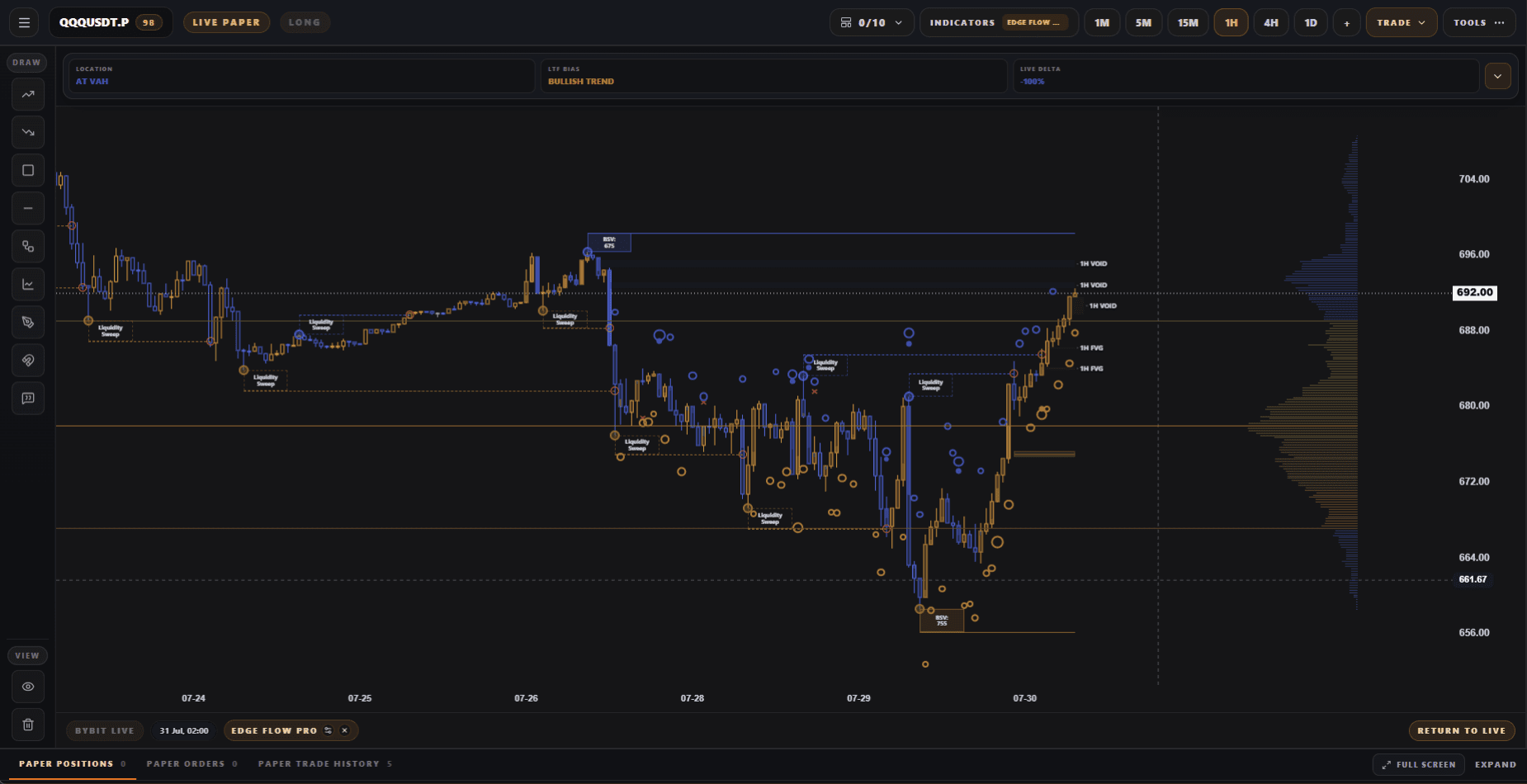
Paper trading
Practise the workflow before putting real money behind it.
Use simulated balances, orders, positions and closures to understand how the trading process works without presenting simulated activity as real exchange execution. For beginners, it’s somewhere to learn. For experienced users, it’s somewhere to test a workflow. Before automation, it gives members somewhere to understand how their setup behaves.
Simulated trading
Existing product UI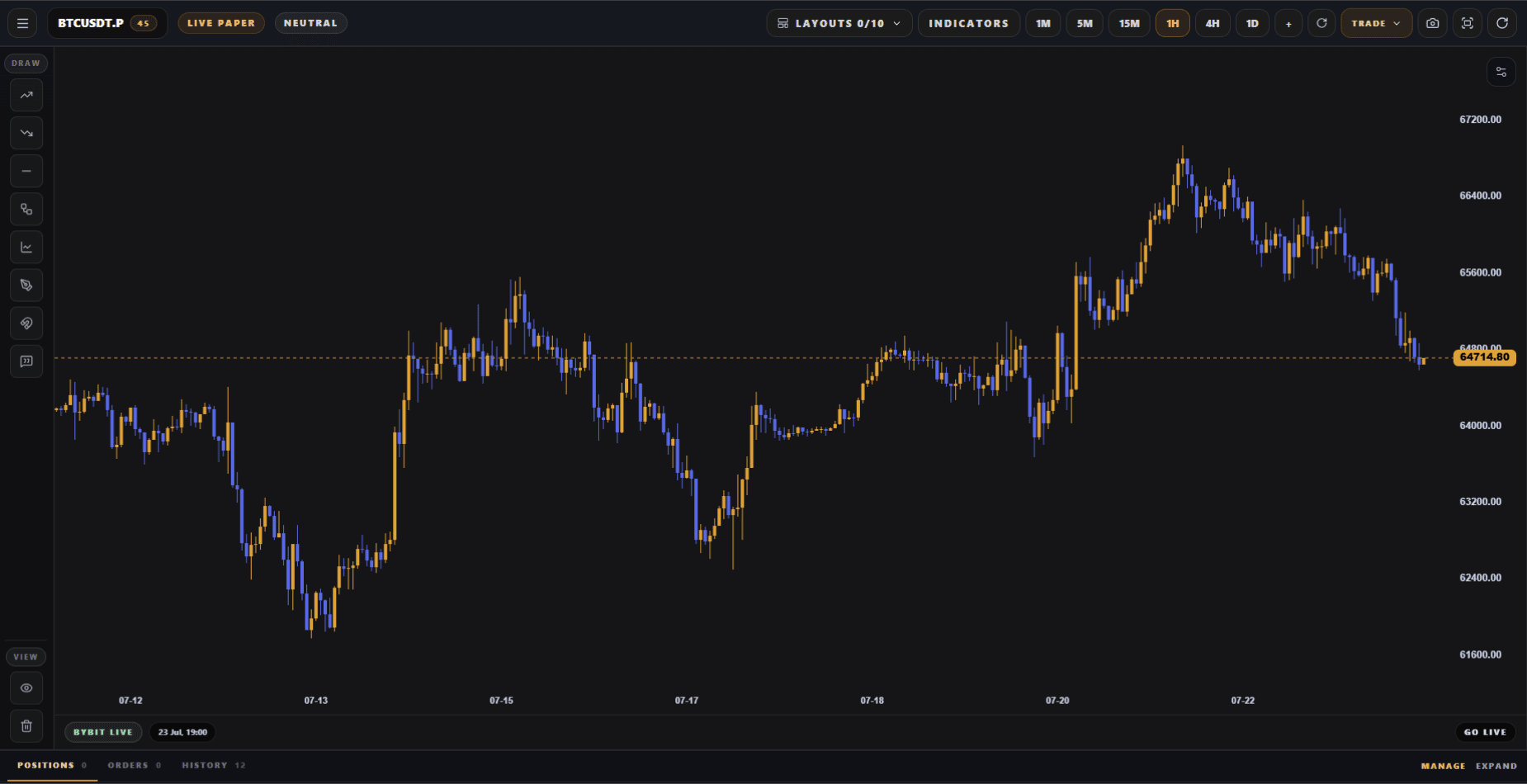
Exchange connections
Connect Edge Theory to where you trade.
Edge Theory supports exchange connections so the workflow can extend from intelligence and practice toward supported exchange-connected trading. Connections provide the bridge between Edge Theory and supported exchanges for functionality that is enabled and available. Paper and exchange-connected activity remain clearly distinguishable.
Do not assume every exchange, execution mode or account state is supported. Availability depends on the enabled workflow.
Connection layer
Mode before action.
Edge Theory
Intelligence, Signals and Bots
Research and configuration stay visible.
Supported exchange workflow
Connection state and mode
Availability depends on the current exchange adapter and its enabled mode.
Current connection catalogue
The member connection catalogue distinguishes enabled adapters from paper-only and vault-ready entries.
Bitget
CONNECTEDUSDT perpetual demo and live execution adapter.
Bybit
PAPER ONLYCurrent simulated market-data venue. Private execution is not enabled here.
Binance Futures
VAULT READYCredential vault area ready; execution adapter is not enabled yet.
OKX Perpetuals
VAULT READYCredential vault area ready; execution adapter is not enabled yet.
Paper
Simulated
Exchange-connected
Mode-labelled
Bot
Member-configured
Supporting ecosystem
Everything around the workflow.
Marketplace, Community, Tournaments and Tools give the wider platform places to discover, discuss, practise and go deeper. They support the core intelligence-to-Bot journey without replacing it.
Community context
Keep the conversation close to what people are actually looking at.
Discuss crypto news, Signals, trades and market ideas with relevant context attached.
Ask
Questions with market context.
Share
Signals and useful work.
Marketplace
Available strategies and Signals.
Selection stays separate from Bot activation.
Explore MarketplaceTournaments
Admin-created simulated competitions.
Participation and XP remain simulated.
Explore TournamentsStart where you are
You don’t need every product on day one.
Edge Theory is one platform, but everyone doesn’t have to use it the same way. Start with the part that helps you understand your next step, then take the workflow as far as you want.
One platform, different entry points
New to crypto?
Start with intelligence, learn the language and practise.
Already trading?
Use Pulse, Signals and EdgeCharts around your existing process.
Ready to automate?
Build your own Bot around an approved source and configured controls.
Different starting points. One platform that can grow with you.
Time and attention
All of this leads to one thing: less time tied to the market.
Pulse reduces how much you need to search. Signals reduce how much information you need to organise yourself. EdgeCharts and paper trading help you learn and practise. Exchange connections bridge the platform to supported exchanges. Bots can take the workflow you’ve configured and keep monitoring when you’re doing something else.
Constant monitoring
Search every market
Check every chart
Wait for something to happen
Configured workflow
Intelligence narrows attention
Your Bot follows its source
Review when attention matters
The market can keep running.
You can go do something else.
Edge Theory
Understand more.
Watch less. Build from there.
Start with market intelligence and learn how the pieces fit together. Use Signals manually. Practise. Connect your workflow. And when you’re ready, build a Bot that doesn’t need you staring at the market every minute.
No Bot required to get started.
Market intelligence and Signals are informational. Paper activity is simulated where shown.