

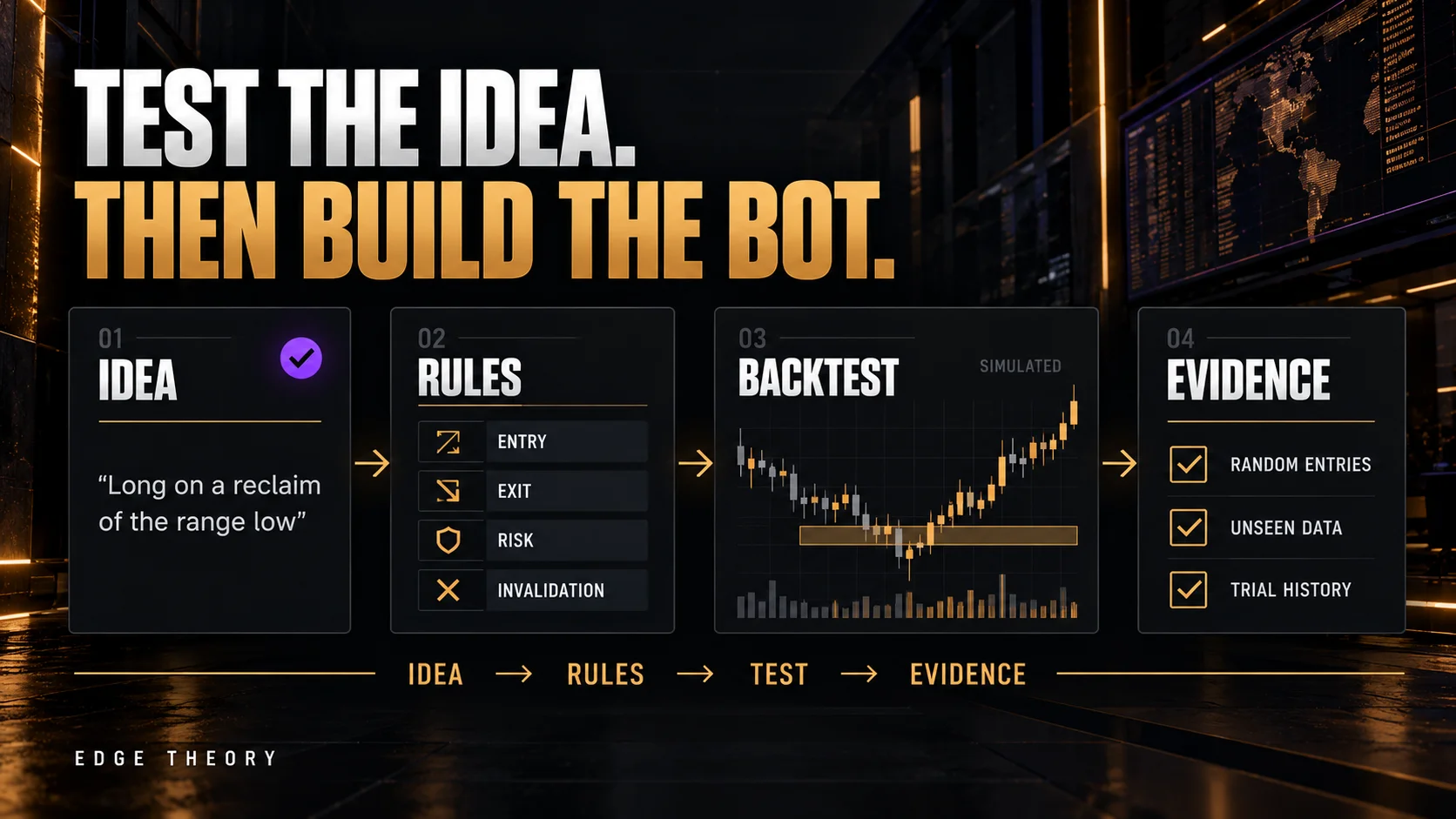
Most trading ideas never get tested. They get traded. A setup works three times on a chart, it feels like an edge, and the market is left to decide whether it was one.
This blog is for traders who would rather find out before the market does. Write the idea down as rules. Test it on historical data with fees, slippage and funding included. Challenge the result. Only then decide whether it deserves a bot. That is the process Edge Theory is built around, and it is what we will be writing about here.
What you'll find here
Testing trading ideas properly
A backtest is the start of a review, not the end of one. We will cover what a backtest can and cannot tell you: the costs it assumed, the data range it used, how many trades it actually contains, and how many versions were tried before the one that looked good. Expect plenty on overfitting, luck and unseen data, because that is where most strategies quietly fall apart.
Bot ideas and rules-based crypto bots
Turning a discretionary read into conditions a machine can follow is a skill in its own right. We will work through entries, exits, stops and invalidation, how to describe a setup precisely enough to automate, and how to spot the parts of an idea that cannot be written as rules. Some posts will simply be bot ideas: a setup written out as rules, ready for you to test yourself.
Weekly trade plans
Each week we break down a trade plan rule by rule: the conditions it waits for, what would invalidate it, how risk is defined and what the trader does if nothing happens. Some plans come from featured traders, shared with their permission; others are Edge Theory's own ideas. These are plans and scenarios, not calls. You will not find price targets or "buy now" here, only the rules and the reasoning behind them.
Tested or busted
Take a popular idea, build it as a bot, and put it through the Evidence Lab. Some ideas survive. Many do not. We publish both, with what the evidence supports, where it fails and what remains unknown. A busted idea is still a useful result, because it is one you no longer have to trade to find out about.
General crypto
Wider pieces on how crypto markets behave: liquidity, volatility, funding and regime shifts, written for traders who want to automate. Context, not predictions.
Pulse and Edge Theory updates
What is new in Pulse AI, Edge Theory's strategy designer, and across the rest of the platform: what changed, why we changed it and how it affects the way you build and test. Brand news lands here too.
The Edge Report
Our Sunday email gathers the week's work into five short sections, read in about five minutes before the week opens:
The regime: BTC against its long-term average, volatility and the context behind the numbers.
Trade plan of the week: one plan's rules and reasoning.
Tested or busted: one strategy and what the evidence says about it.
The week ahead: the scheduled economic events worth knowing about.
From the Lab: what is new in Pulse and the community.
Who it's for
Systematic traders who want to see the working behind a result, not just the equity curve.
Bot builders who want more confidence in a strategy before it runs.
Traders using AI to design strategies who want those strategies challenged, not flattered.
Discretionary traders curious about automating who suspect part of their process could be written as rules, and want to find out which part.
If you are looking for trades to copy or promised returns, this is not the place. If you want to understand why something works, or why it doesn't, you are in the right one.
What Edge Theory is
Edge Theory is a crypto trading platform for designing, testing and running automated strategies. In practice, that means:
Pulse AI: describe a trading idea in plain language and Pulse turns it into editable bot rules, with its assumptions written down where you can check them.
Strategy Lab: read and edit every rule, build from 156 supported building blocks, and backtest on historical data with no daily backtest limit on any plan.
Evidence Lab: challenges a saved strategy for overfitting, luck bias and performance on unseen data, including a comparison against random entries, then gives a reasoned A to F robustness grade. A strong backtest can still earn a low grade.
Bots: simulated paper bots are available on every plan. Live bots are available on paid plans through supported exchanges, currently Bybit, Binance, OKX and Bitget, with Hyperliquid coming soon, using trade-only keys with withdrawals disabled. Live trading involves risk and can lose money.
Edge Theory Originals and the Marketplace: ready-made and member-published strategies whose rules and research you can review before deciding what to explore.
Community: members share bots, trade cards and Evidence Cards by choice, and talk through what they would test next.
Tournaments: simulated competitions, running now, each with published rules and recorded standings.
How we'll write
Backtested, simulated and live results are always labelled separately, and none of them is a promise about the future.
That rule applies to every article on this blog. A backtest is a historical simulation under stated assumptions. A simulated bot shows how rules behave without sending orders to an exchange. A live result is a live result. We will not blur the three, we will not publish price targets, and we will show what failed alongside what held up.
Where to start
Start free. The Free plan includes 40 AI credits a month, Strategy Lab, historical backtesting and 1 simulated bot. No card required.
Subscribe to The Edge Report to get the week's regime, trade plan and tested-or-busted breakdown every Sunday.
Bring one idea to Pulse. Pick the setup you trust most, write it down as rules and see how it stands up.
Welcome aboard. We look forward to testing some ideas with you.